Saturday, 15 June 2013

Karachayevo-Cherkessia Parliamentarians Demand Genocide Denial Be Designated a Criminal Offense

Regnum -- At the June 13 session of the National Assembly (Parliament) of Karachayevo-Cherkessia, deputies passed a resolution on submitting to the Russian State Duma a draft federal law "On Amendments to the Criminal Code of the Russian Federation", which prescribes penalties for denying  or trying to justify genocide, a correspondent for the REGNUM news agency reports.

Karachayevo-Cherkessia law-makers propose to add to Article 357.1 of the Criminal Code and introduce penalties for the public denial, justification, approval or understatement of the scale of acts of genocide (political repression) expressed at a meeting or other public event with the aim of defending those who committed these crimes, or with the aim expressing solidarity with them. It is proposed to introduce a penalty of up to 1 million rubles [$31,515, EUR 23,618], or compulsory works for a period of up to 320 hours. It is proposed to penalize the same acts committed via the mass media by a fine of up to 2 million rubles, or by imprisonment for a term not exceeding three years.

The legislative initiative was initiated by the chairman of the committee on nationality policy, foreign relations, local government and non-profit organizations of the Karachayevo-Cherkessia Legislative Assembly, Ahmad Ebzeyev. The parliamentarian explained in an interview with REGNUM that the bill must undergo the procedure of approval by the State Duma Council before State Duma deputies begin to review it.

Commenting to REGNUM on this initiative by regional deputies, the author of the idea of criminalizing denial of instances of genocide, head of the Department of History of the Fatherland at the Karachayevo-Cherkessia State University, Doctor of Historical Sciences Professor Rustam Begeulov noted that a legislative ban on the justification or denial in the media, scientific publications or during mass events of repressions on ethnic, race, religious or class grounds should in the first instance reduce the intensity of the discussion of such issues. “This should strengthen the realization in society that any attempt to justify such crimes is inadmissible. The discussions have long since gone beyond a purely historical framework and are continually acquiring emotional and political overtones, all of which simply hinders normal research by scholars and historians whom first one side then the other tries to accuse of bias and taking the side of a particular nation,” Begeulov thinks.

We would remind you that the idea of introducing a bill criminalizing denial or justification of genocide was publicly proposed on 17 May at an international conference in Cherkessk entitled "The Rights of Repressed Peoples in the World Today (a propos the 70th Anniversary of the Deportation of the Peoples of Southern Russia)." The plans to introduce this bill were announced at  the conference by the keynote speaker, Karachayevo-Cherkessia parliament deputy speaker Ruslan Khabov, who is the leader of the public organization Karachai Alan Halk that represents the Karachais. His report analyzed the extent to which the basic legal acts of the Russian Federation concerning the rehabilitation of repressed peoples have been implemented, and expressed the intention of the regional parliament to propose to the State Duma including in the Criminal Code provisions for liability for the public approval or justification of all kinds of repression on the basis of ethnicity.

This article was published by REGNUM and is translated from Russian.

Monday, 30 May 2011

Sergei Bagapsh, Abkhazia’s Leader, Dies at 62, by Ellen Barry

The New York Times, MOSCOW — Sergei V. Bagapsh, who led the Black Sea enclave of Abkhazia through a tumultuous effort to gain independence from Georgia without being absorbed by Russia, died Sunday in Moscow. He was 62.

Mr. Bagapsh had successful surgery to remove growths on his lung on May 21, but succumbed to complications that ended in heart failure, medical officials told the Interfax news service.

The affable manner of Mr. Bagapsh, who governed Abkhazia as its president, concealed the strategic thinking of a chess player, a quality he used to maneuver the nationalist upheaval of the post-Soviet period. Though he was an ethnic Abkhaz, he married into a large Georgian family, and remained on good terms with his in-laws even as Abkhazia’s separatist war in the early 1990s tore the country apart.

The August 2008 war between Georgia and Russia was a victory for Mr. Bagapsh, who had long lobbied the Kremlin — or any other government, for that matter — to recognize Abkhazia as a sovereign nation. The slender wedge of beachfront land, once a cherished vacation spot for the Soviet nomenklatura, or ruling elite, was now under the protection of the Russian Army, and Mr. Bagapsh was received in Moscow as a bona fide head of state.

But he found himself in a far more difficult position than he had anticipated. Russians lined up immediately to grab prime real estate and privatize energy and transportation infrastructure, which could be crucial to preparations for the 2014 Winter Olympics in Sochi, Russia. Under extraordinary pressure from Russia to compromise, Mr. Bagapsh also had to answer domestic critics who accused him of selling off Abkhazia’s assets.

“After the August war, Abkhaz society — and this was also the tragedy of Bagapsh — is, if anything, more divided than it was before,” said Peter Semneby, the former European Union special representative to the South Caucasus, who met many times with Mr. Bagapsh.

“You have those who are very uncomfortable with the dominating role of Russia, and what they see as selling out, many of whom were behind the independence movement in the first place,” he said. “On the other hand, you have those who see a lot of economic opportunity. And these interests are very much being played out against each other.”

Both Russia’s president, Dmitri A. Medvedev, and its prime minister, Vladimir V. Putin, said on Sunday that they would view Mr. Bagapsh’s body to say farewell in person.

His death will very likely usher in a competition for power in Abkhazia, with Russia and Georgia jockeying for direct access to the next leader. Candidates for early presidential elections, scheduled for three months from now, will most likely include Prime Minister Sergei M. Shamba, who has advocated a “multivector” foreign policy that includes alliances with Turkey and the West; Vice President Aleksandr Ankvab, a close ally of Mr. Bagapsh; and Raul Khajimba, a former K.G.B. officer who left government to head an opposition party.

It has proved difficult to manipulate Abkhaz politics in the past. In 2004, Russia threw its weight behind Mr. Khajimba: pop stars were flown in to hold free concerts in his name; Mr. Putin, then the president, appeared with him on billboards; Russian lawmakers threatened to cut off the tangerine imports that were the territory’s economic lifeline. Mr. Bagapsh’s opponents, meanwhile, suggested he would cave to pressure from Tbilisi because his wife was Georgian.

Mr. Bagapsh won anyway. Russia imposed an import blockade, so that tons of tangerines rotted in trucks at the border. But Mr. Bagapsh moved into the presidential headquarters and set about negotiating with Mr. Khajimba, eventually forming a coalition government.

Recalling that brutal political war in an interview two years ago, Mr. Bagapsh was characteristically easygoing.

“I understood that it was politics, and it would pass, and I was right,” he said. “All the people who swore at me, said I was a mafioso and a bandit and so forth — today, they are my friends.”

Guram Odishariya, a writer, grew up not far from Mr. Bagapsh in the Abkhaz capital, known in Georgian as Sukhumi and in Abkhaz as Sukhum, a city where men gather on an embankment to play chess. Mr. Bagapsh showed an early aptitude for the long game, he said.

“He is the kind of person who plays 15 steps ahead,” he said. “There are leaders who play a child’s game, but Bagapsh is not one of them.”


Related

Sunday, 15 May 2011

Beware of Greeks bringing gifts, by Richard Berge

antigeopolitics, May 14 -- Ahead of the anniversary of the mass killings and forced exile of the Circassians from their ancestral lands in the Caucasus at the hands of the Russian Empire in the second half of the 19th century, which will be marked on the 21st of May, the parliament of Georgia has again mooted the possibility of recognising these events as genocide. The Circassian genocide has had a profound impact on Circassian history and national identity, and the process towards its recognition is given huge importance by many Circassians, especially among the diaspora in Turkey and the wider Middle East. However, until recently, no state has shown willingness to officially recognise the Circassians genocide as such. This changed in late 2010, when following a speech by president Mikhail Saakashvili, the process towards recognising the Circassian genocide was begun by the Georgian parliament. This process further sparked a conference on the Circassian genocide held in Tbilisi in March 2011, organised by the Jamestown Foundation and with the participation of the so-called American Committee for Peace in Chechnya, both known instruments of the US foreign policy establishment.

Since its failed bid to recapture the breakaway republics Abkhazia and South Ossetia in the 2008 August War, the Georgian overture towards the Circassians has formed part of a charm offensive to shore up support for Georgia among the peoples of the Russian North Caucasus, and drive a wedge between Russia and the peoples of the region. As seen from Tbilisi, the conflicts in the Georgian breakaway territories of Abkhazia and South Ossetia are merely the result of Russian efforts to destabilize an independent and sovereign Georgian state, and Georgia reckons that two can play this came. Ostensibly under the aegis of pan-Caucasian unity and solidarity, Georgian president Mikhal Saakashvili has ordered the abolition of visas to Georgia for citizens from North Caucasus republics, as well as the establishment of the Russian-language satellite TV channel “First Caucasian” or PIK in Russian. The idea was to give the inhabitants of the North Caucasus more possibilities for education and trade in Georgia, and also provide them with a source of “unbiased” information that is not controlled by the Russian government.

While Russian authorities have universally condemned Georgia’s moves, many in the North Caucasus republics themselves have been cautiously optimistic or supportive. However, there is considerable lingering distrust of the Georgian actions and their motives in the North Caucasus for historical and ideological reasons. The Circassians especially point to the role played by Georgia in the Russian conquest of the North Caucasus, where the Georgian nobility participated on Russia’s side against Circassians and other highlanders in the Great Caucasian War, which events eventually led to the Circassian genocide. Circassians also note what they see as double standards in Georgian dealings with them and what they see as their “brother nation”, the Abkhaz, especially in the light of Georgia’s attempts to suppress Abkhaz national aspirations during the 1992-1993 war in Abkhazia. In any case, it is widely believed that the Georgian conception of Caucasian unity is designed to further Georgia’s ambition to become a regional leader, a role which the other Caucasian peoples, fiercely independent and assured of their own position in the region, would naturally be wary to grant it.

There is also notable cause for concern when assessing the renewed Western interest in the Circassians and their predicament. Some Western opinion formers and policy makers acting through organisations such as the Jamestown Foundation have primarily the national interests of the West and the United States at heart, and seek to use the Circassians and other peoples of the North Caucasus as tools to further their own geopolitical agenda. This turn of events has historical precedents in British interest in the Circassian cause in the period running up to the Cirmean War, which even included pledges of military support to the Circassians in their fight against the Russian Empire. However, Circassian hopes in the British eventually turned out to be misplaced, as Britain abandoned all aid to the Circassians following the end of the war. Current Western support for the Circassians is not likely to be more reliable.

It is not at all clear either that recognition of the Circassian genocide by Georgia or other third parties would have the positive effect that Circassian nationalists, especially in the diaspora, are hoping for. Rather than force concessions from Moscow on cultural or political rights, or exact some form of apology and reparation for past wrongdoings, it is more likely that recognition will only harden the front between Russia and the Circassians and worsen the lot of Circassians currently living in Circassia. Examples here can be readily drawn from the efforts of many countries to recognise the Armenian genocide, which so far has failed to make Ankara relent on its position. In addition, the stubbornness by which recognition has been pursued, especially by the Armenian diaspora, have actually helped to further complicate the relationship between Armenia and Turkey, forestalling beneficial economic and diplomatic steps like the reopening of the Turko-Armenian border. Consequently, those among the Circassians who are prepared to accept outside support for their cause would do well to ponder who their allies are, and which possible consequences recognition could entail.


Richard Berge holds a BA in Politics and Georgian language from the School of Oriental and African Studies at University of London, and a MA in Politics, Security and Integration from the School of Slavonic and East European Studies at UCL. He has worked for the Norwegian Embassy in Baku, Azerbaijan in 2009 and the European Centre for Minority Issues in Tbilisi, Georgia in 2010, focusing on human rights, freedom of information and minority rights in both countries. He is currently looking to publish his MA thesis on the political situation of the Armenian minority in Abkhazia.

Related Issues

Sunday, 6 February 2011

Terrorism meets xenophobia in Russia, by Charles King and Rajan Menon

Terrorism meets xenophobia in Russia
Deadly tit-for-tat between ethnic Russians and North Caucasus migrants is escalating.

Los Angeles Times

By Charles King and Rajan Menon
February 6, 2011

If current demographic trends continue, within the next half-century Muslims will constitute a sizable part, perhaps even a plurality, of Russia's population; indeed, Moscow currently has more Muslim inhabitants than any other European city. And unlike those in Amsterdam or Paris, most of Moscow's Muslims are citizens, not immigrants — products of the Russian Empire's 19th century southward expansion. In the coming decades, Muslim peoples from Russia's North Caucasus and Volga regions, together with migrants from neighboring Central Asia and Azerbaijan, will continue to displace Russia's Slavic core and reshape how the country defines itself.

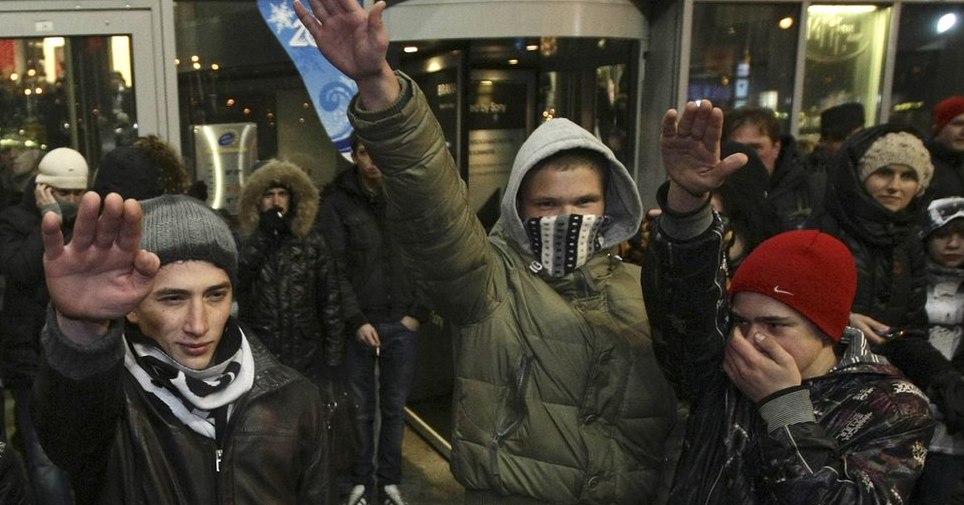
These shifts pose new challenges to Russia's stability. Last December, following the slaying of an ethnic Russian in Moscow, allegedly by a man from the North Caucasus, mobs of chanting youths took to the streets, arms raised in Nazi salutes. "Moscow for Muscovites," read one of their tamer bits of graffiti. Photos and video showed other young men — pummeled, bloodied and dark-haired — cowering behind a thin phalanx of police officers.

Russia has an undeniable terrorism problem emanating from its restive North Caucasus, a region featuring authoritarian politics and a growing Islamist insurgency. But it also has a xenophobia problem. Xenophobic mob attacks on Muslim minorities in the national capital and other major cities could make terrorism attacks occasions for additional bloodshed. This deadly tit-for-tat threatens, especially in the context of an economic crisis, to stoke ethnic and religious conflict, empowering Russia's increasingly visible ultranationalist forces.

The people targeted in the violent episodes exemplified by Moscow's December demonstrations were primarily from the North Caucasus, a mountainous stretch along Russia's southern border with Georgia and Azerbaijan. In the wake of two wars in Chechnya, an insurgency has gained ground across the area. That, along with poverty, joblessness and the indiscriminate roundups of young men by state security services, has spurred out-migration from the area since the 1990s.

The more chaotic the North Caucasus becomes, the larger the exodus of people to Moscow, St. Petersburg and other cities, and in turn the greater the likelihood of violence between far-right hooligans and Russian Muslims.

Russia's leaders understand the stakes. President Dmitry Medvedev has labeled the North Caucasus his country's greatest internal problem. After the December riots, he denounced the fanatics for sowing disorder. Likewise, Prime Minister Vladimir Putin warned against extremism of all sorts.

Moscow has also tried to stabilize the North Caucasus. It has increased investment in Chechnya, seeking to rebuild the republic after the weakening of the insurgency there. Still, the other North Caucasus republics — unfamiliar places such as Dagestan and Kabardino-Balkaria — remain mired in poverty and unemployment. The Kremlin has sought to buy off power brokers in the region, hoping to rely on the local strongmen to keep order and crack down on suspected insurgents.

But this is not the kind of thoroughgoing reform that is needed. And the indiscriminate dragnets deployed against Muslim men in the region have driven even more young people to leave or to join the insurgency's ranks.

In the meantime, anti-migrant chauvinists in major cities farther north have made life even more miserable for those fleeing the North Caucasus. Politicians have inflamed the situation by painting all Muslim migrants as criminals and aliens. And the Russian media tend to denounce the chaos while ignoring the victims — unless they are ethnic Russians.

Russia has seen all this before. The eruptions of violence against neighbors who were also perceived as insidious outsiders marked Russia's early 20th century. Anti-Jewish pogroms in then-Russian cities such as Kishinev and Odessa assaulted one of the Russian Empire's most vibrant communities. But they also hurt Russia: by increasing emigration, staining the country's international reputation and creating a repertoire of violence against Jews that was reprised during the Bolshevik revolution and Russian civil war.

Then, as now, the thugs were a tiny part of the population. Neither today's extreme nationalists nor the Islamist terrorists are representative of the communities they claim to speak for — a point Medvedev, who has praised Islam as a vital part of Russian history, has been at pains to make.

It is a fine line the Russian government must walk. In responding to terrorism, the government must be careful to separate the terrorists from the rest of Russia's large Muslim community. Medvedev's use of the term "pogrom" to describe last December's riots is a step in the right direction. Without such clear signals from Moscow, Muslims in and from the North Caucasus — who, after all, have been the main victims of Islamist terrorism for years — will wonder whether the country they now call home is big enough to embrace them.

The Domodedovo Airport bombing points to the need for better intelligence and policing to protect all of Russia's citizens. Russia's creaking security services, often heavy handed and inefficient, have scored some remarkable successes against insurgents, and the airport attack will be another opportunity to reexamine the performance of state institutions. But the larger challenge for Russian citizens and their government involves coming to terms with a future in which the Muslim periphery is no longer so peripheral.

Charles King is a professor at Georgetown University and the author of "Odessa: Genius and Death in a City of Dreams." Rajan Menon is a professor of political science at City College of New York/City University of New York and the author of "The End of Alliances."


Friday, 17 December 2010

Cherkesov's relatives treat murder of "Spartak" fan as tragic accident

Caucasian Knot, Dec. 13, 2010 -- Relatives and friends of Aslan Cherkesov, a resident of Kabardino-Balkaria, suspected of murdering Yegor Sviridov, a football fan of "Spartak" in Moscow, consider what had happened to be a tragic accident, which was caused by a fatal coincidence.

"I know the pain of loss," said Sonya Cherkesova, Aslan's mother, "six months ago I buried my elder son. I express my sincere and heartfelt condolences to the mother of the deceased boy. Along with that, I want to declare to the whole world: my son is not a killer! He could not kill a man just so - whatever they talk about him!"

The traumatic pistol from which the fatal shot was made belonged to Aslan Cherkesov for two years. "He's never used it during this time," his mother said. "I know my son: if his life had not been in real danger, he wouldn't have used it this time either."

The "Caucasian Knot" has reported that Sviridov was shot dead from a traumatic pistol at night on December 6 in Moscow in a mass brawl. Not far from the place of the incident militiamen detained Aslan Cherkesov, 26, a resident of Kabardino-Balkaria and found a traumatic pistol on him. Under decision of the court, Aslan Cherkesov was detained for two months - till February 6, 2011. Cherkesov himself declared his innocence, saying that his actions were self-defence, and he fired blindly, without aiming.

According to his relatives, Cherkesov with his friends was in the bar at "Rechnoy Vokzal". His three friends went out a bit earlier, while he paused to buy cigarettes. When he went out, his friends were lying on the pavement, and four persons were beating them. Aslan had his arms twisted out, and he was thrown on a car hood. Then, according to his story, they started choking him. When he saw a "rosettes" (a broken bottle neck with sharp edges looking like petals) in hands of one of the attackers, he pulled his pistol out of the back pocket of his trousers and made three shots into the air. The fourth shot was fatal.

Sonya Cherkesova does not deny that her son had administrative offences: "But those were minor offences; the murder, of which my son is accused, is quite a different thing."

"Journalists write that Aslan did not study anywhere and did not work. They try to make a complete 'rogue' out of him. I am very indignant with this, it's a lie! My brother has higher education, he worked as a rescue in the Ministry for Emergencies (MfE), and then was engaged in real estate business - he worked in a realtor company," said Ann Cherkesova.

Besides, the woman was furious that her brother was announced to be a nationalist: "How can he be a nationalist, when he has a Russian wife, who was pregnant with his child?"

Ann told the "Caucasian Knot" correspondent about her intention to meet the family of the deceased young man. "Despite the threat to kill us, arriving from 'Spartak' fans, we'll surely meet the family of Yegor Sviridov to tell them that we are very sorry about what has happened," she said.

See earlier reports: "Rally of football fans in Moscow escalated into clash with OMON fighters," "In Moscow, 3000 fans commemorate "Spartak" fan killed in a mass brawl," "Spartak fans against RFU's refusal to toughen punishment to Anzhi."


Related Issues

Thursday, 16 December 2010

Fearing Clashes, Police Detain Scores

Riot police officers detaining young men they suspect of seeking to stage interracial riots outside the Kievsky train station in Moscow on Wednesday.

By Natalya Krainova - The Moscow Times

Thousands of riot police patrolled downtown Moscow on Wednesday, detaining at least 800 people, conducting pat-downs and closing the Yevropeisky shopping center and access to the nearby Kievskaya metro station to stave off violence in the area.

Police feared that thousands of young people, inflamed over the killing of an ethnic Russian in a brawl with Caucasus natives on Dec. 5 and a subsequent riot by ethnic Russians that targeted Caucasus natives last weekend, would heed online calls to stage a violent rally in front of the Yevropeisky mall at 6 p.m.

Hundreds of young people — Caucasus natives and ethnic Russians — gathered in the vicinity of the mall on Wednesday evening, many of them chanting “Russia for Russians” and “Moscow for Muscovites.”

Police detained anyone whom they considered a potential threat, dragging them to waiting police buses.

“The situation in Moscow is under the control of law enforcement agencies. Residents have no reason to feel threatened,” police spokesman Viktor Biryukov said, Interfax reported.

But the situation remained tense late Wednesday, with many young people itching for a fight. A Moscow Times reporter overheard four boys aged 14 to 15 discussing how to carry out an attack on Caucasus natives as they drank alcoholic cocktails near the Noviye Cheryomushki metro station. “Now we’re going to find a [racial epithet] to beat,” said one. “What’s most important is to make sure that there are no cops around.”

A 20-year-old Caucasus native was hospitalized after he was beaten in a Moscow region commuter train by a group of about 20 young people screaming nationalist slogans, a police source told Interfax.

Shortly before 6 p.m., a fight broke out between ultranationalists and Caucasus youth, some of them armed with baseball bats and metal rods, on Smolenskaya Naberezhnaya, near the Yevropeisky mall. At least five people were injured, Interfax reported.

Riot police were also patrolling Manezh Square, where 5,500 football fans and nationalists angered over the death of football fan Yegor Sviridov, 28, staged an unsanctioned rally that turned violent Saturday when protesters attacked a group of Caucasus natives who passed by.

The Japanese Embassy recommended that its nationals stay off Moscow streets because “riots are possible,” an embassy source told Interfax.

Mayor Sergei Sobyanin promised Tuesday to deal harshly with anyone who attempted a repeat of Saturday’s violence. President Dmitry Medvedev has ordered the police to punish those responsible and offered assurances on Twitter that the authorities remained in control.

But in the hours after Saturday’s riot, a message appeared online that called for revenge and was attributed to a Caucasus blogger.

“I call on you to arm yourselves if possible and have no fear and not to hide at home,” said the blogger’s message. “We will decide at the scene about further actions.”

The call, which bloggers said was first posted on the social network VKontakte.ru but was deleted by late Saturday, was reposted more than 3,300 times on LiveJournal by late Wednesday.

Police have downplayed the message as a provocation by ultranationalists, but many young people appear to have heeded the call.

By late Wednesday, police had detained at least 800 people, including 400 near the Yevropeisky mall, police spokesman Biryukov said. Many of those detained were Caucasus natives carrying air guns and other weapons, he said. Other reports said the number of detainees reached 1,200.

About 600 young people chanting nationalist phrases and obscenities marched from Kievsky Station toward nearby Bolshaya Dorogomilovskaya Ulitsa, Interfax reported. Riot police walked beside the crowd, blocking an attempt by several dozen youth to shut off Bolshaya Dorogomilovskaya Ulitsa to traffic, RIA-Novosti reported.

By 6 p.m., the Yevropeisky mall and the exit from the Kievskaya metro station were closed.

The threat of violence hung over other cities as well. About 60 people were detained near Sennaya Ploshchad in St. Petersburg on suspicion of planning a riot, Interfax reported, citing local police. In downtown Samara, about 100 young people were detained on suspicion of planning to hold an unsanctioned gathering, local police told Interfax.

North Caucasus leaders urged young people to refrain from violence. Chechen President Ramzan Kadyrov warned at a news conference late Tuesday that “pressure” would be placed on any Chechens who took part in rallies in Moscow.

“If any one of our Chechen young men allows himself to take part in mass protests in Moscow … he will be pressured through his family and friends according to our traditions and customs, which do not tolerate disobedience,” he said.

Said Amirov, mayor of the Dagestani capital, Makhachkala, called on Caucasus natives to opt for “a dialogue on the level of people of authority representing the conflict parties” instead of rallying on Moscow’s streets, RIA-Novosti reported.

The All-Russian Association of Fans also asked football fans not to take part in rallies Wednesday “because it might have a negative effect on the fan community,” association head Alexander Shprygin told Interfax.

Meanwhile, the security services were searching the Internet for extremist speech and determining IP addresses of those who posted extremist messages, RIA-Novosti reported, citing an unidentified senior security official.


Related Issues

Far right goes on rampage during anti-immigrant clashes in Moscow

Many of the demonstrators shouted nationalist slogans and gave Nazi salutes.

By Shaun Walker in Moscow - The Independent

Police detained around 1,000 people in central Moscow yesterday in an attempt to contain ethnic tensions between Russian nationalists and migrant workers – sparked by the killing of a football fan – from flaring into pitched street battles.

Thousands of riot police patrolled locations across the city, including the Kiev Station, where there were rumours that a massed fight could take place between the two groups. Police checked documents and confiscated knives and other weapons, calling on the crowds to disperse and detaining anyone who disobeyed orders, herding them into waiting buses.

The Russian capital has been tense since the weekend, when protests over the murder of Yegor Sviridov, a Spartak Moscow football fan, turned violent. Mr Sviridov was killed earlier this month, allegedly shot dead by a native of Russia's troubled, mainly Muslim, North Caucasus region.

On Saturday, thousands of football fans and nationalists packed Moscow's Manezh Square, near the Kremlin, and began attacking anyone of a non-Slavic appearance. In terrifying scenes, riot police had to tell bloodied victims to hide under cars as they fought off the angry mob and waited for reinforcements. After the fighting on the square was brought under control, mobs of youths entered the metro system, and proceeded to pull people who looked non-Russian from trains and assault them on the platform. Dozens were injured.

Yesterday, nationalist groups said they were planning to meet again, while the Russian blogosphere had been awash with rumours that hundreds of Chechens and other natives of the North Caucasus were travelling to Moscow to exact revenge for Saturday's attacks. The fear was of a clash between two heavily armed gangs bent on revenge.

In the end, while the police detained hundreds, there was little in the way of fighting. Groups of nationalists shouted "Russia for Russians!" and "Moscow for Muscovites", while scuffles broke out at various locations across the Russian capital. But the serious battles that had been expected did not materialise, and most of those detained were released shortly afterwards.

The situation in the Russian capital remains tense, however, with nationalist leaders using rhetoric designed to stoke tension. "Today Moscow is a dangerous city, mainly due to immigrants from the North Caucasus and Central Asia," said Alexander Belov, a nationalist figurehead who formerly led the Movement against Illegal Immigration. "Russia is now a battleground. If you go out unarmed, you have minimal chance of surviving. I call on every Russian to carry a gun or at least a knife – not to do so is an act of criminal irresponsibility."

President Dmitry Medvedev has called for order and promised that those provoking riots will be punished.


Related Issues

Monday, 13 December 2010

Geopolitics For Dummies: What Does The Collapse Of The Soviet Union Really Mean? By Eugene Ivanov

The Ivanov Report, December 13, 2010 -- Regardless of how one would characterize the collapse of the Soviet Union -- as the "greatest geopolitical catastrophe of the century" or just its "major geopolitical disaster" -- everyone appears to agree that it was one of the 20th century's most fateful geopolitical events. Russia's Prime Minister Vladimir Putin once called it a "genuine drama" for the Russian nation. In contrast, many in the West celebrated the disappearance of the Soviet Union as a Cold War trophy and a sign of the "end of history."

While the fact that the Soviet Union has "collapsed" is not in dispute, little attention is being paid to what the Soviet Union, the Union of the Soviet Socialist Republics (USSR), actually was. The only thing everyone seems to remember is that the USSR was composed of 15 so-called Soviet Socialist Republics (SSR). So when the USSR was "collapsing", the "collapse" was supposed to proceed precisely along the borders separating the SSRs, resulting in the creation of 15 newly independent states. Can it get any simpler than that?

Not so fast. In 1991, the Soviet Union was a true administrative monster that held together as many as 173 different territorial entities: 15 above-mentioned SSRs, 20 Autonomous Soviet Socialist Republics (ASSRs, parts of SSRs), 8 autonomous regions, 114 regions, 6 territories ("край"), and 10 autonomous districts.

Countless changes to this administrative puzzle have occurred in almost 70 years (1922-1991) that the Soviet Union was in existence: new districts, regions and republics emerged and then disappeared with the speed of images on a slide show; borders between entities were drawn and redrawn, and then redrawn again, by a restless hand of a mysterious artist; shuffling smaller "republics" between bigger ones was taking place almost as often as shuffling cards in professional poker. Just a few examples. In 1936, the Kazakh and Kyrgyz ASSRs ceased being parts of the Russian Soviet Federative Socialist Republic (RSFSR), the largest SSR in the USSR, and were "upgraded" to the Kazakh and Kyrgyz SSRs, while the Karakalpak ASSR was transferred from the RSFSR to the Uzbek SSR. In the 1950's, a swath of RSFSR territories bordering the Kazakh SSR went under the Kazakh SSR's jurisdiction. In 1954, the Ukraine SSR got a gift from the RSFSR: Crimea (the Crimea region of the RSFSR).

Think about that for a moment. Crimea has been an intrinsic part of Russia for almost 200 years, with the Russian Empire spending blood and treasure, during the Crimean War of 1853-1856, to keep the peninsula within its borders. And then, a Communist apparatchik, Nikita Khrushchev, following the best traditions of the Soviet Union's arbitrariness, just transferred Crimea from Russia proper to Ukraine. (The reason for Khrushchev's decision -- to commemorate the 300th anniversary of the reunification of Ukraine with Russia -- sounds especially absurd today.) Is it not incumbent upon anyone who wants to put away the legacy of the Soviet Union to condemn this act of supreme state stupidity (the term "state treason" would perhaps be more appropriate) and to demand that Crimea be returned to where it truly belongs: in Russia?

Granted, the borders of some Soviet Socialist Republics -- the three Baltic SSRs (Estonia, Latvia, and Lithuania) come to mind first -- did reflect historically established demarcations between stable and mature nations. But others did not. Instead, they were created by the malicious mind of the world's most creative nation builder, Josef Stalin. Take the Georgian SSR. This product of Stalin's imaginative cartography included the Abkhaz ASSR and South Ossetia autonomous region, both placed under Georgian rule in contradiction to historic and common sense and despite protestations by both the Abkhaz and Ossetian people. So when in 1991, Georgia declared its independence from the Soviet Union, both Abkhazia and South Ossetia rightfully demanded their independence from Georgia. They won it, after an armed rebellion, in 1992-1993. But the Western governments have refused to accept their de facto independence. Western strategists apparently believed that in this part of the Soviet Union, its "collapse" should be partial, so that Georgia's independence from the USSR was legitimate, despite the fact that Georgia joined the USSR voluntarily, but the independence of Abkhazia and South Ossetia from Georgia was not, despite the fact that both entities were made part of Georgia by Stalin's order.

Our Secretary of State ought to consider this the next time she articulates U.S. policy in the region. The Madam Secretary should remember that by vowing to uphold Georgia's "territorial integrity", she is attempting to preserve the legacy of the Soviet Union (and fulfill the dreams of its bloody dictator).

(The Soviet Union is hardly the only place where creative geopolitical cartography was applied. The West applauded the "collapse" of Yugoslavia, a mini-"evil empire" for many. But for the NATO strategists, the "collapse" was not complete enough, so NATO took away, by brutal force, Kosovo from Serbia. But when Serbs in Western Kosovo wanted to join their compatriots in Serbia to stop the ethnic cleansing at the hands of the Kosovars, the West cried foul and vowed to uphold the "territorial integrity" of the narcomafia heaven that contemporary Kosovo is.)

It will take time to heal all the wounds -- political, economic, social, cultural, and physological -- the precipitious and disorderly disintegration of the Soviet Union has caused to Russia and its people. It will also take time to fully understand what the Soviet Union was and was not in the history of the Russian state. The burden of this work lies on the shoulders of the Russians themselves. But we in the West can help, too. First, by accepting that today's Russia is not a Soviet Union and will never be one. Second, by realizing that the "collapse" of the Soviet Union is still going on, and we can't just end its history by whim.


Sunday, 12 December 2010

Soccer fans clash with police in Moscow

(CNN), December 12 -- Police have released more than 60 soccer fans detained Saturday in downtown Moscow riots that injured 29 people, an interior department spokesman said Sunday, according to state-run media.

Hundreds of soccer fans clashed with Moscow police as an unsanctioned nationalist-tinged mass memorial for a fellow supporter turned violent, according to state media.

The confrontations took place in Manezh Square, outside the Kremlin, and led to the arrests of 65 Spartak Moscow fans for "disobedience," Moscow police spokesman Viktor Biryukov said, according to official Russian news agency Itar-Tass.

An undetermined number of people -- including several police -- were hurt in the clashes, news agencies reported.

The head of the Spartak Moscow fan club told the semi-official news agency RIA Novosti that the showdown had nothing to do with sports but instead was rooted in problems in Russian society. Nationalist group members stirred the clashes, Russian Football Union president Sergei Fursenko told the news agency.

Some 5,000 fans of the Moscow soccer club had gathered to remember a fellow fan, Yegor Sviridov, who was killed December 6 in northern Moscow by several men from Russia's Caucasus region.

Police blocked their rally, but fans then started a fight with men from Caucasus, reported Itar-Tass. Hundreds of fans chanted nationalist slogans, with some throwing flares and smoke pellets at police.

Video on the independent Russia 24 network showed helmeted police officers clubbing protesters and dragging them away.

Anti-riot police used batons to try to break up the gathering and help facilitate traffic through the area, according to Itar-Tass. Some fights broke out, and several police officers were injured.

Moscow police chief Vladimir Kolokoltsev used a megaphone to urge the crowd to disperse, saying, "You have let (your) steam out. Now you'd better go home," reported Itar-Tass. Kolokoltsev later credited Interior Ministry official Yuri Demidov for giving "exhaustive answers" to fans' questions and calming them down.

Still, according to Itar-Tass, about 300 supporters "crushed everything" on their way from the square to the subway, breaking lights on escalators and smashing windows on a train.

Kolokoltsev said that he was confident that all those involved in the December 6 confrontation in northern Moscow would be arrested. Itar-Tass reported Friday that two of those suspects had already been detained.

Source: CNN

Related issues

During an unauthorized rally fans at the Manege Square a few dozens people attacked migrants from the Caucasus (Ria Novosti)

Thursday, 9 December 2010

21 May 1864: From Dmitri Kipiani to Grand Duke Mikhail Nikolaevich Romanov

Excerpt from Stanislav Lakoba's ''Двуглавый орел и традиционная Абхазия'' (Double-headed eagle, traditional Abkhazia)

In the suppression of the last pockets of resistance in the Caucasus, Georgian militia, loyal servants of the autocratic state, played a significant role. Together with the Russian troops, they took part in the victory parade at Krasnaya Polyana on 21 May 1864. And on 9 June, as a crowd gathered, Tiflis Marshal of the Nobility, Dmitri Kipiani, greeted the Governor of the Caucasus, Grand Duke Mikhail Nikolaevich Romanov, with the words:

"Your Imperial Highness! You have completed the conquest of the Caucasus and have thus incorporated in history an event of enormous importance that is inseparable from your name. Persons selected by the Georgian nobility bring your Imperial Highness congratulations in the name of all social classes."

In June, the autocratic state abolished the Abkhazian monarchy and instituted a temporary "military-national administration." Thereafter, Abkhazia was renamed the Sukhum Military Department of the Russian Empire. General P. N. Shatilov became Head of the Department on 12 July 1864.

*****

В подавлении последних очагов сопротивления на Кавказе большую роль сыграли и грузинские ополчения - верные служители самодержавия. Вместе с русскими войсками они принимали участие в торжественном параде победы на Красной Поляне 21 мая 1864 года. А уже 9 июня при стечении народа тифлисский предводитель дворянства Дмитрий Кипиани обратился с приветствием к наместнику на Кавказе, великому князю Михаилу Николаевичу Романову:

"Ваше Императорское Высочество! Вы довершили покорение Кавказа и тем внесли в историю неразлучное с вашим именем событие громадной важности. Избранные грузинским дворянством, приносим Вашему Императорскому высочеству поздравление от имени всего сословия".

В июне самодержавие упразднило Абхазское княжество и ввело временное "военно-народное управление". Отныне Абхазия была переименована в Сухумский военный отдел Российской империи. Начальником отдела 12 июля 1864 г. стал генерал П. Н. Шатилов.


Двуглавый орел и традиционная Абхазия
Станислав Лакоба

********************

Appendix:

- Many Georgians were eager to take advantage of the privileges associated with imperial service, associate themselves with Europe's notion of progress, and also distinguish themselves from nearby rival and Islamic peoples such as the North Caucasus mountaineers.[5]

- Service records from the imperial era left in what has recently been renamed the Georgian National Archive illustrate the important role played by Georgians in various wars against both mountaineers and the Ottoman Turks.[6]

- Colonel Giorgi Tsereteli from Kutaisi, for example, not to be confused with the writer and sometime theater critic referred to later in this article, managed to survive fighting in Chechnia and Dagestan from 1855-59, service on the Lezgin Line after the conquest, and combat in the war of 1877-78 against the Turks. In 1876 he helped put down a rebellion in Svanetia.[7]

- After the conquest, a Georgian was considered sufficiently reliable to administer troublesome Dagestan oblast¢ in the 1880s. [8]

- Tbilisi served not only as the base of imperial administration and a growing imperial educated society, but also as an anchor for the Russian military in their prosecution of the long Caucasus War.[9]

- Tbilisi was host to important innovations in Russian imperial policy. The well-known geographic, ethnic, and religious complexities of the region perhaps contributed to a general willingness on the part of Russian officialdom to innovate in its administration of this frontier. Tsar Nicholas I himself lost patience with the seemingly interminable war and granted extensive authority to Prince Vorontsov, an unusually powerful and independent figure in the imperial administration. As Anthony Rhinelander has explained, Vorontsov was experienced in the borderlands and well-acquainted with the Caucasus, where he began his military career as an adjutant to Georgian Prince P. D. Tsitsianov (Paata Tsitsishvili) in the early 19th century.

The Dilemmas of Enlightenment in the Eastern Borderlands: The Theater and Library in Tbilisi, by Austin Jersild and Neli Melkadze http://muse.jhu.edu/journals/kritika/v003/3.1jersild.html

Notes

[5] sakartvelos sakhelmtsipo saistorio arkivi (Georgian National Historical Archive, Tbilisi, hereafterSSSA) f. 4, op. 3, 1846–1855, d. 181, ll. 22, 60

[6] SSSA f. 7, op. 8, 1861–74, d. 2, ll. 21–52.

[7] SSSA f. 229, op. 1, 1884–85, d. 127, ll. 33–37.

[8] SSSA f. 229, op. 1, 1888, d. 220.

[9] On the war and Sufism in the North Caucasus, see Moshe Gammer, Muslim Resistance to the Tsar: Shamil and the Conquest of Chechnia and Daghestan (London: Frank Cass, 1994), and Anna Zelkina, In Quest for God and Freedom: The Sufi Response to the Russian Advance in the North Caucasus (New York: New York University Press, 2000).

Thursday, 23 September 2010

Interview: Zakayev Says ‘No Irresolvable Issues’ Between Russia, Chechnya

RFE/RL | September 23, 2010

Akhmed Zakayev, head of the Chechen government in exile, returned to London on September 22 following his brief detention in Poland on an international arrest warrant requested by Russia. Zakayev had been in Poland to address the World Chechen Congress, which was meeting to develop a plan for ending the violence in the Russian republic and secure its “de-occupation.” He says he will return to Poland when necessary to participate in an extradition hearing.

Zakayev spoke with RFE/RL Russian Service correspondent Natalya Golitsyna about his experience in Poland and about the status of the Chechen independence movement.

RFE/RL: You have said you were a victim of the political games of Poland and Russia. What do you mean by that?

Akhmed Zakayev: I mean that the Polish leadership and the Polish prosecutors had every reason to ignore the request that Russia sent to Poland because I had already been detained twice under that request. The first time was in Copenhagen [in 2002], and in Britain there was already a court process that lasted nearly a year on the basis of this very same request.

So Poland, as a member of the European Union, had every right to ignore this from a legal point of view. But in this matter, I think, political matters trumped the legal and rights aspects. That is why, in order to please Russia, they initiated an extradition procedure. In this sense, undoubtedly, I think that I became a victim because the congress and the efforts we were making in Copenhagen were nearly ruined, although we’d discussed all this with the Polish leadership and Polish politicians five or six months ago. And it was on the basis of agreement with them that the congress was arranged in Poland.

At the last moment, when Russia learned that I would participate, there was pressure on Poland and these papers were sent in order to disrupt the congress. Unfortunately, Poland helped them in this.

RFE/RL: Some people think that the idea of Chechen independence is no longer realistic. They say that since the September 11, 2001, terrorist attacks, all Chechen groups – particularly separatist groups – are considered terrorists in the West.

Zakayev: I absolutely do not agree with that. Quite the opposite. There have been strong changes in international politics regarding Chechnya and Chechen subjects. The first is the recognition of Kosovo by the United States and the European Union. The second is Russia’s recognition of [the breakaway Georgian regions of] Abkhazia and South Ossetia. The third was the decision of the international tribunal in The Hague that Kosovo’s declaration of independence from Serbia did not violate international law.

All three of these developments in international politics indicate that Chechnya and the Chechen question remain on the agenda.

As far as the claim that Chechens themselves are tired and have given up on the idea of independence goes, it has nothing to do with reality. Chechnya is a concentration camp, and usually people in concentration camps try to survive. They don’t go around making political demands. A good example is the Holocaust. No one then was talking about the creation of a state of Israel. They were trying to survive, and they did.

And that is what is happening in Chechnya now – the people are just trying to survive. Chechens will never give up because the idea of Chechen independence and freedom is not something [former Chechen President Djokhar] Dudayev or [former Chechen President Aslan] Maskhadov or Zakayev invented. It is a national idea that exists and will be supported until it becomes reality.

That is why I look at the future of Chechnya now with greater optimism than 10 or 15 years ago. And what is most important – in Russia itself there is the understanding that the current situation in Chechnya has to be changed. What is going on in Chechnya right now is costing Russia a lot, and this situation is all held together by one person, by the personal ambitions of [Prime Minister Vladimir] Putin. Because a person who entered the political scene through Chechen blood, through the Chechen war, cannot admit that this was a mistake and that it is necessary to try something else.

This is the only reason that the conflict is continuing, and it will continue as long as Putin maintains a political position in Russia. That may be another 12 years….But for the national liberation movement, 10 or 12 years is not enough time to suppress or halt the movement itself.

RFE/RL: Does the idea of independence have broad support in Chechnya itself?

Zakayev: The fact that people in Chechnya today do not speak about independence is a sign of the times. I remember some examples. After the 1944 deportation and after the Chechens returned in 1956-57, during this period until 1990, the Chechens lived as if nothing had happened, as if everything was forgotten. But the slightest spark, which happened in the 1990s when there was the coup attempt [against Soviet President Mikhail Gorbachev] and such waves passed through Russia, it was precisely the 1944 deportation that became the detonator for everything that came later.

And compared to that, what has happened in the last 10 years…. Even old people who lived through both experiences say that the deportation was nothing compared to what is happening now. It is a land mine planted in Chechen society. And sooner or later, it will explode. But I am categorically against any revolutions. I don’t think the Chechen people can survive yet another revolution. It would be a national tragedy. That is why we must find a transition from the current regime to a normally formed power structure chosen by the Chechen people.

RFE/RL: Last summer you were expected to hold talks with the authorities in Chechnya, with the authorities in Russia. What has happened in the last year that made these good intentions collapse?

Zakayev: The problem was that they demonstrated their insincerity. What they stated publicly and what really happened were two different things. They declared good will and a desire for me to return home. But when we ran up against concrete questions that had to be settled, everything came to a halt.

The first matter was the people being held in Russian camps. That is, about 25,000 people. The second matter was the return of Maskhadov’s body. The third was the matter of not persecuting the relatives of Chechen fighters. Without settling these questions, it is not possible to discuss the consolidation of Chechen society. And without consolidating society, it is impossible to work out a unified political program that could be the basis for a lasting peace.

Everything ended on these formulas, because these three questions were within the competence of Moscow and Chechnya. But Moscow was not ready to settle these questions. And that’s where it ended.

RFE/RL: Those were your demands. What were you willing to concede to make such a dialogue happen?

Zakayev: We said from the beginning that Chechens have never set themselves the goal of defeating Russia. The matter of independence was never an end in itself for Chechens. Chechen independence is a guarantee of security. At one point, Putin said that the status of Chechnya is not important for Russia. On the basis of these two political components, we could have found settlement that would have been absolutely acceptable for Russia and for Chechnya, that would have satisfied everyone and facilitated a lasting peace.

There is the peace agreement signed by Maskhadov and in that agreement there is a project for another agreement where the Chechen side declared a single defensive space, a single economic and customs space. All these questions were resolvable. I am confident that even now there are no irresolvable issues in relations between Russia and Chechnya.

Source: RFE/RL

Related

Wednesday, 22 September 2010

The Caucasian Wars Go Pacific, by Thomas de Waal

The National Interest | September 21, 2010

India, Nauru, Tuvalu. What do these three states have in common? The latter pair, both tiny islands in the Pacific Ocean, are two of the world’s smallest nations. By my calculations, India is 44,000 times more populous than Nauru and Tuvalu put together.

But it is UN General Assembly month, everyone who is not a permanent member of the Security Council is equal and a vote is a vote. Which is why the Georgia-Russia conflict has now opened up a new warm front in the Pacific.

Strangely enough, I know a little about Nauru, population 14,000, area eight square miles (or about one eighth of the District of Columbia), because the first head of state I ever interviewed was its president. His was the smallest state in the world and I was a very junior reporter with the BBC, so we were a good match. It was 1992 and I was compiling a report on a controversial shipment of plutonium that Japan was sending home by sea. Nauru had risked the wrath of the Japanese by saying it would not allow the ship to pass through its territorial waters. I telephoned half way across the world to be told that President Bernard Dowiyogo was actually in Kensington, London, that week and would be happy to give me an interview.

Nauru slipped from my consciousness until the day in 2009 when it suddenly and to much hilarity became the fourth country to recognize Abkhazia and South Ossetia as independent states. It was all of course about money. Back in 1992 I hadn’t realized that poor courageous Nauru was also virtually bankrupt. It used to have spectacularly large deposits of phosphate, formed by centuries of bird droppings. Mining by British, German and Australian companies briefly gave Nauru the largest income per capita in the world in the 1960s, but then the phosphate began to run out, the landscape was devastated and the revenues were mismanaged. From the 1990s the microstate dabbled in offshore banking, was accused of being a haven for money laundering and for several years provided a home to a group of Afghan refugees whom Australia was prepared to pay not to keep.

All these ventures ran out of steam, until the government hit on a more durable revenue-earning scheme: converting UN membership into cash. Which is why Nauru has the distinction of being the only country in the world to have recognized as independent Kosovo, Abkhazia and South Ossetia—no hang-ups here about Europe’s post–Cold War borders. It also managed to recognize, de-recognize and then re-recognize the Taiwanese government, causing Beijing twice to sever diplomatic relations. I can only guess how much Nauru earned from these nifty about-turns, but we do know that, after recognizing Abkhazia and South Ossetia, the Russians donated nine million dollars to refurbish the island’s port.

Washington plays this game too, having had Nauru bulk up the No vote on the UN’s recurring resolutions on “Peaceful settlement of the question of Palestine” in which the United States tends to look rather lonely. In 2009 164 countries voted in favor of the latest such resolution; of the seven countries who voted against, four, alongside the United States, Israel and Australia, were Pacific microstates, Nauru among them.

Now Georgia has found a way to strike back, via Tuvalu, the closest Pacific state to Nauru. On September 11, it was reported that the government in Tbilisi is “providing financial aid to the permanent mission of Tuvalu to the United Nations.” Later it was confirmed that Georgia had paid for a medical shipment to Tuvalu worth “about $12,000,” or roughly one dollar for each of the island’s inhabitants.

And, hey presto, Tuvalu was one of fifty countries (along, incidentally, with the Marshall Islands and Micronesia) which voted in favor of the recent Georgian-sponsored United Nations General Assembly reaffirming the right of return of all refugees to Abkhazia and South Ossetia. Naturally Nauru (and the Solomon Islands) were among seventeen nations voting against.

Fortunately, there are no signs of a new Caucasian war breaking out on the equator. Pacific geography means that although Nauru and Tuvalu are formally neighbors, they are actually eight hundred miles apart—and besides the South Ossetians have no warships. But both Georgia and Russia should be careful. Paying obeisance to Pacific microstates with the population of a U.S. suburb will only encourage little territories in both the North and South Caucasus—South Ossetia, North Ossetia, Ingushetia, the list continues—to ask the question, “If they can be UN members, why can’t we?”

Thomas de Waal is a senior associate at the Carnegie Endowment for International Peace.


Related

Tuesday, 21 September 2010

An Unfaltering Gaze, by Dmitry Babich

Russia Profile, September 21, 2010

The Jobs of Provincial City Historians Are Back in Vogue

Russia’s regions are now using the history of their cities to forge their unique local identities.

The proclivity toward writing about a city, or even a town, usually the one where the author grew up, became widespread among Russia’s historians during the 1990s. Yuri Borisyonok, the editor in chief of the Rodina magazine, a monthly collection of historical essays and research published on glossy paper with pretty pictures, explained: “In the Soviet times, the best way for a historian to make a career was to go to Moscow or St. Petersburg, get an education and find a relatively well paid job with some scientific body, studying general problems of the country’s history—a research institute or an academic magazine.” To graduate from the historical faculty of Moscow State University and then return to one’s native town to teach at a school or, heaven forbid, to work at a local museum or an archive meant to fail. But this changed after the collapse of the Soviet Union. “The state stopped distributing apartments, and payment for research work became laughably small,” Borisyonok said. “Historians in Moscow and St. Petersburg found themselves fighting for survival. In this situation, opportunities offered by the governors and mayors in Russia’s provinces suddenly became more appealing.”

Indeed, with the shift from a centralized economy to economic federalism that occurred during the 1990s, Russia’s regions suddenly developed greater interest in their local histories. The rich historical past of some of these regions (primarily Novgorod, Kazan, Yaroslavl, Vladimir and Pskov, among many others) offered an opportunity to attract more tourists and to raise the region’s prestige. Even the governors of not very affluent regions developed an interest in their local histories and allotted funds for historical research from local budgets. At some stage, part of this historical research took a self-aggrandizing turn, justifying certain regions’ separatist ambitions. But the easing of political tensions in the country and general pragmatism later led to a certain shift of interest from “ethnic history” to “city history.” The latter provided more opportunities to mold a local identity beyond ethnic definitions, since Russia’s cities and towns, as elsewhere in the world, tend to be multiethnic, with a history of belonging to different states at different times.

A city of many nations

A good example of how a city’s history can be important for an entire region or even for the whole of Russia is Sochi, the future home of the 2014 Winter Olympic Games. A city of 330,000 people, it is a good example of a troubled but fascinating history, reflecting some of the most important stages in the history of Russia and its neighbors.

Located on the territory of the Byzantine Empire and ruled by the mostly Greek-speaking successors of ancient Roman emperors, Sochi was a part of medieval Circassia and a protectorate of the Ottoman Empire from the 15th century until 1829, when it became part of Russia as a result of Turkey’s defeat in the Russo-Turkish war of 1828 to 1829. Seen as a key to the Caucasus Mountains, the city became the scene of protracted fighting between the advancing Russian colonizers and the local tribes. In the 1860s a large part of the local Adyghe population was faced with a choice: to be deported to Turkey or to move to other areas of the Russian Empire. As a result of tsarist policies the indigenous people were outnumbered by Russians—a situation characteristic of our times, too. At the same time, this period of history, decried by Circassian activists as “genocide,” serves today as a pretext for protests against holding the Olympics in Sochi. The format of urban (not ethnic!) history allows one to tackle even this thorny issue with tact, telling the truth without insulting anyone’s feelings.

After the end of hostilities in the Caucuses the city fell into its usual slumber, which continued until the early 1930s, when Joseph Stalin developed a taste for vacationing in that city. (Contrary to rumors about his workaholic character, during most of the 1930s Stalin spent at least two months every year vacationing in the south). Coupled with a similar passion for the place on behalf of the “first person in the Red Army,” Kliment Voroshilov, this became the driving force behind the city’s first general reconstruction, started by special Politburo order on October 9, 1933. The reconstruction was done on a grand scale, but in the post-Stalinist period of Soviet history the pace of change somewhat slowed, as Stalin’s successors in power preferred Crimea. But with the collapse of the Soviet Union, Crimea found itself a part of independent Ukraine, and thus inaccessible for domestic vacationing. With Crimea out of business, Sochi was given a new boost by the continued presence of Russian presidents.

Both Boris Yeltsin and Vladimir Putin became great fans of Sochi. They pumped funds into it, citing the fact that after the collapse of the Soviet Union, Sochi became the only major health resort with access to warm seas on Russia’s territory. On July 4, 2006, Putin’s tireless lobbying of Sochi brought the desired result: the International Olympic Committee chose Sochi as the location of the 2014 winter games, preferring it to South Korea’s Pyeongchang and Austria’s Salzburg. Interestingly, every one of these major events and epochs in the city’s history found its devoted researchers among brilliant local (and outside) historians.

A deadly profession

The period before the Russo-Turkish war was best covered by Yuri Voronov, a native of the neighboring Abkhazia. After Abkhazia became a de facto independent country in 1993, separating itself from the nationalist Georgia of the early 1990s and fending off an attempt to bring it back to heel by the multi-faced Eduard Shevardnadze in 1992, Voronov devoted a lot of effort to studying the ties between Sochi and the ancient Abkhazian kingdom in the seventh to the tenth centuries. It was a classic attempt to use history to build a national identity. In Voronov’s case, however, it was not mere opportunism, but a conscious attempt to bring to fruition the work of a lifetime.

In 1979, long before Gorbachev’s liberalization revealed the dormant animosity between Georgians and Abkhazians, Voronov published the book “The Antiquities of Sochi and its Environs.” During Georgia’s short but bloody war with the multiethnic splinter state of Abkhazia, Voronov became a member of the Abkhazian Parliament. In 1994, meeting a group of journalists, Voronov described the predicament of the Abkhazian population, then cut off from Sochi by Russia’s border guards. Acting on the orders of Russia’s leadership, which at the time tried to ally with Eduard Shevardnadze, the Russian border guards in the north and the Georgian army in the south isolated Abkhazia for several years from the outside world. This alliance with the White Fox, as Shevardnadze is known in his own country, proved to be remarkably short-lived and futile, since Abkhazians never “crawled on their knees” back to Georgia, as Tbilisi had hoped.

“Sochi fascinates me as a wonderful example of multi-ethnicity,” Voronov said at the time. “If local history teaches us anything, it is that borders in the Caucasus are always bloody and dangerous. This area forms a very complex and multi-faceted entity, and you can never divide it to everyone’s satisfaction. Ethnocentrism and the construction of mono-ethnic states in the Caucasus is often tantamount to genocide. Sochi, with its ancient walls, portal graves and magnificent antiquities, has always been at one of the crossroads of the world’s civilizations.”

Unfortunately, Voronov was murdered in September of 1995 by an unknown criminal near his home in Tsebelda, an Abkhazian valley not far from Sochi. Public opinion linked this murder to Voronov’s activity as the leader of the Russian community in Abkhazia. Voronov’s death marked the end of a period of immature freedom and separatist tidings ushered in by Mikhail Gorbachev’s perestroika reforms in the mid-1980s. A new, more down-to-earth vision of city history was needed.

The stench of Stalin’s failed struggle

And this vision was realized in the work of Sochi’s younger city historian, Lyudmila Kosheleva. Unlike Voronov, she did not go deep into the region’s ancient past, but instead concentrated on the fascinating story of Sochi’s reconstruction in the early years of Stalin’s rule. In the early 2000s, Kosheleva laid her hands on the fascinating correspondence of Stalin’s Politburo members discussing ways to clean up Sochi, which in 1933 to 1934, very much like nowadays, actually turned into the Soviet Union’s summer capital.

In a letter to Abel Yenukidze, the secretary of the Central Executive Committee of the Soviet Union, published by Kosheleva in the Rodina magazine, the nominal head of the Red Army Kliment Voroshilov complained in 1933: “Everything is done in a very sloppy way… Since 1923 I regularly take (like hundreds of others) the dirt baths in Matsesta; this treatment must have some effect on my body. So, do you think our doctors keep track of my condition, draw the necessary conclusions, etc.? Nothing of the sort! In our sanatoriums this process is set in a lamentably shabby way. [Deputy Chief Sanitary Inspector Mikhail] Metallikov is naïve to the point of being criminal about it. He does not know anything, believes everything and allows himself to be deceived as the worst kind of idiot.”

It should be noted that in 1937 Metallikov was executed on Stalin’s orders. Officially, his meeting with the son of exiled Leon Trotsky at a scientific conference in Paris was the reason, but obviously the pitiful condition of Matsesta baths did not earn Metallikov a lot of friends in the Politburo. Metallikov’s sister Bronislava Metallikova was the wife of Alexander Poskryobyshev, Stalin’s personal secretary, but even her intervention did not save the poor doctor. The same terrible fate awaited Bronislava herself in the late 1930s, along with Voroshilov’s addressee, Abel Yenukidze. Why? Probably because, as Stalin wrote in September 1935 in a special message to Molotov, Kaganovich and Voroshilov, “The water in Matsesta baths stays dirty, upon taking a bath it is still necessary to wash oneself again in fresh water at home… A special check revealed that the tanks had not been cleaned since 1933, developing a covering of dirt 30 centimeters thick. And this dirt is dumped with Matsesta water into the baths of the patients.”

Somehow, the Bolshevik leaders, always eager to require self-sacrifice from other citizens, were remarkably attentive to their own health and abhorred being sacrificed to some standard proletarian negligence. Kosheleva’s city-centered research reveals this better than hundreds of pages of abstract dissertations. And probably the reasons behind the cruelty of Stalin and Voroshilov should be looked for in more prosaic matters than Shakespearean ruminations about genius and villainy.

It should be noted that Matsesta’s waters stayed dirty even after a special order from the Politburo on October 9, 1933, which required putting all the dirt into a special sewer. The execution of Sochi’s mayor Alexander Metelyov in 1937 did not help, either—a demonstration of the “effectiveness” of Stalin’s system.